

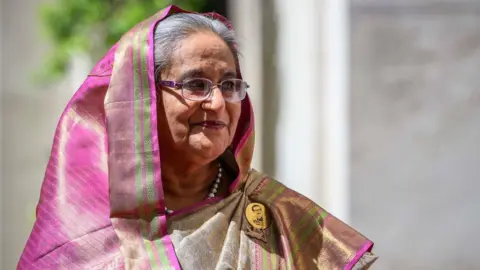
The ex-prime minister of Bangladesh has been given a death sentence for human rights violations due to her crackdown on youth demonstrations which resulted in her ousting.
The court convicted Sheikh Hasina of permitting fatal actions to be used against demonstrators, 1,400 of whom lost their lives during the turmoil in the previous year.
Hasina was tried without her presence by the International Crimes Tribunal (ICT) in Bangladesh, since she went into exile in India following her ouster in July 2024.
Prosecutors accused her of being the mastermind of numerous deaths during the protests. She has refuted every accusation, calling the trial as "unfair and agenda-driven".
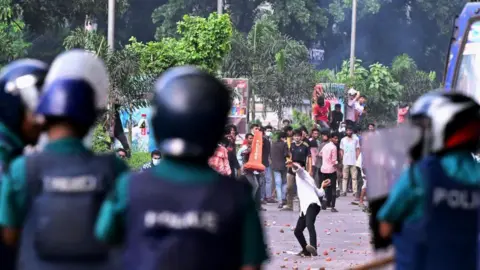
The decision signifies a pivotal moment for Bangladesh, as the protests revealed fury over long-standing suppression. Families of those killed and harmed had requested severe punishments.
Answering the judgment in a five-page statement, she expressed the execution sentence was the temporary leadership's way of "eliminating her political faction" as a electoral entity and that she was satisfied of her administration's performance on civil liberties.
"I do not fear to meet my challengers in a proper tribunal where the evidence can be weighed and tested fairly."
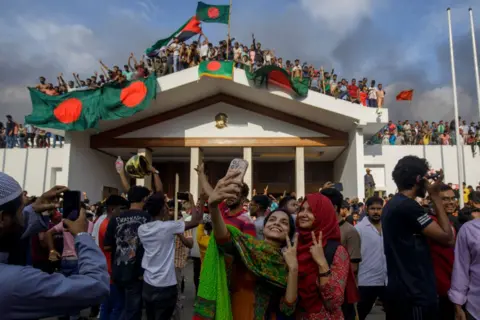
The nation's capital, Dhaka, where the legal proceedings occurred, was under tightened security ahead of the ruling on Monday, with several of her detractors staging a rally and cheering as the sentence was declared.
The capital witnessed a recent spike in disturbances, with multiple explosives detonated and coaches ignited in the period preceding the verdict.
At least one bomb explosion was recorded in Dhaka on Monday morning, with no victims identified, local police official Jisanul Haque told news organizations.
The protest movement led by students last year commenced through requests to remove public sector reservation policies but evolved into a wider anti-government movement.
United Nations rights examiners said in a report in February that the approximately 1,400 deaths could amount to "crimes against humanity".
The report documented the shooting at point-blank range of some protesters, the deliberate maiming of additional individuals, arbitrary arrests and abuse.
Unauthorized recordings of a telephone conversation involving Hasina confirmed by media examinations earlier this year indicated she had approved the use of "deadly arms" in July 2024. The sound file was broadcast in court during the legal process.
Before the decision, relatives of those fatally injured in the unrest told news agencies they wanted the former leader to face strict penalties.
One relative, whose brother was shot dead in July 2024, said he wanted "strict sentence" for Hasina and others who have "performed revengeful deeds and misused their authority".
A different family member, whose spouse died near Dhaka in August 2024, said she wanted Hasina's sentence to be "carried out before the election".
"Exclusively thereafter the families of those killed [in the protests] will obtain solace in their hearts."
After her departure, an caretaker administration led by economic expert Muhammad Yunus has assumed power. A national vote is scheduled for February 2026.
Nevertheless, the Awami League, Hasina's political party, was prohibited by Bangladesh's temporary leadership in May.
She alerted last month that if the her faction's nominees were banned from standing in the forthcoming vote, millions would boycott the vote.
This decision presents a foreign relations issue for both nations. The Bangladesh government has asked her extradition but until now India has demonstrated no inclination to acquiesce.
Hasina's state-appointed lawyer her legal counsel said he was "disappointed and hoping the outcome had varied".
"I am unable to challenge because my represented individuals are away; that's why I am disappointed," he continued.
Recently, the defense attorneys said they had submitted an immediate petition to the UN pointing out serious fair trial and due process issues at the ICT.
Hasina was tried together with her former home minister and top law enforcement officer.
While the sentence provides certain resolution to relatives of the deceased in the protests, it may do little to soothe the nation's partisan rifts.
"The anger against Hasina and the Awami League has not subsided," a Dhaka-based rights activist stated to press agencies. "Both she and the organization has expressed regret or demonstrated contrition for the fatalities of countless citizens."
The advocate declared "This creates challenges for the faction to gain approval by a majority of people in this nation."
The campaigner further stated that the penalty was not resolution for the families of those killed and injured.
"We assist multiple individuals who underwent irreversible limb loss, they are now disabled, because of the suppression. They cannot pardon her."
A journalist, an observer of Bangladeshi affairs, said the "very nature of the conviction could make it increasingly challenging" for the political faction to become a regular participant of Bangladeshi politics again.
This might transform if "a form of contrition emerges and a distancing from Sheikh Hasina and the old leadership," he said.


